The writings of St. John Paul I about the merciful love of God have had a tremendous confirming and strengthening impact in the universal church. Pope Benedict XVI rightly points out, “The mystery of God’s merciful love was at the centre of the pontificate of my venerated predecessor.” (Regina Caeli address, April 23, 2006)
In 1981 St. John Paul II wrote an entire encyclical dedicated to the Divine Mercy entitled Dives in Misericordia (Rich in Mercy) pointing out that the core of Jesus’s mission was to reveal the merciful love of the Father. It was he who beatified Sr. Faustina, the apostle of mercy in 1993. Later in 2000 he cononized her and established ‘Divine Mercy Sunday’ so as to pass the message of divine mercy onto the new millennium. On August 17, 2002 he consecrated the whole world to Divine Mercy.
His interest in St. Faustina which began even before his pontificate stretches back to the days of his youth and his life as a young priest.
He often visited the convent in Lagiewniki where she was buried for moments of private prayer. However, his announcement of Divine Mercy Sunday left many liturgists and pastors stunned. “Why did the Pope,” they wondered, “create a new feast because of his personal devotion to the private revelations to a Polish mystic?”
The Pope was well aware that the visions of St. Faustina and the devotions flowing from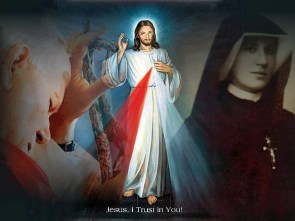 these remain in the official category of ‘private revelations.’ The church’s doctrines on divine mercy are not based on any such revelation. They are based on Holy Scripture, the deposit of faith handed down from the apostles and the liturgical traditions of ancient apostolic communities. In establishing this feast the Holy Father was not interested in commemorating St. Faustina’s mystical experiences.
Nevertheless, the fact that they so powerfully express the central truths that lay at the heart of the Gospel makes them significant.
Some devotional practises that come from her private revelations (such as the chaplet and the veneration of the image of divine mercy) enable us to contemplate and celebrate the paschal mystery, the mystery that lies at the very heart of the ‘Public Revelation’ passed down to us from the apostles. Therefore, clearly he saw these revelations as just more than a collection of private revelations. He saw them as prophetic revelations given to us to proclaim the gospel of the merciful love of God in a way specially suited to meet the needs of our era.
Pope John Paul II stressed often that Divine Mercy is not just a doctrine to be believed by mind or another devotion involving acts of piety. Rather it is a personal encounter with the merciful saviour himself. The image, the feast, the chaplet etc., are only means to lead us to this personal encounter. In his Regina Caeli address on Mercy Sunday in 1995 he said,
“Dear brothers and sisters we must personally experience this (tender-hearted mercy of the father) if, in turn we want to be capable of mercy. Let us learn to forgive! The spiral of hatred and violence that stain with blood the path of so many individuals and nations can only be broken by the miracle of forgiveness.”
In the homily on the occasion of the consecration of the whole world to the Divine Mercy at the international D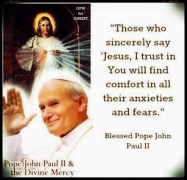 ivine Mercy shrine in Logiewniki he said, “How greatly today’s world needs God’s mercy! In every continent, from the depths of human suffering, a cry for mercy seems to rise up. Where hatred and the thirst for revenge dominate, where war brings suffering and death to the innocent, there the grace of mercy is needed in order to settle human minds and hearts and to bring about peace. Wherever respect for human life and dignity are lacking, there is need of God’s merciful love, to whose light we see the inexpressible value of every human being. Mercy is needed to insure that every injustice in the world will come to an end in the of truth.”
We do not need to hesitate to call Pope John Paul II as the great Pope of Mercy. He not only propagated the message of mercy through his words and writings but also exhibited remarkable capacity for mercy and forgives when he visited Mehmet Ali Agca, and spent a few moments with him. In a way he dedicated his entire pontificate, even to his last breath, to spread the message of mercy. Indeed just before his death on Saturday, April 2, 2005, he received Holy Communion of the vigil mass for Divine Mercy Sunday. He had already prepared his Regina Caeli Address for the following day, the Divine Mercy Sunday. In that message he said,
“It is a love that converts hearts, and gives peace. How much the world needs to understand and accept Divine Mercy.”
The world is in need of mercy and the merciful heart of the Father is in search of messengers to take the message of mercy in our time, in our context and in the place where we are. Are we ready?


 Vox Divini