It was a practice to send an obituary notice to other Carmels when any Carmelite nun dies. A month before St Therese died one of the nuns said, “I really wonder sometimes what mother prioress (superior) will be able to say about Sr. Therese. It won’t be easy, for though the little sister is very good she has certainly never done anything worth mentioning”. In fact, she was a simple Carmelite nun who lived a short life in an obscure convent at Lissieux, France. She died before she was even 25. (1873-1897). She left behind her a few letters and 240 pages of prose which narrates her short uneventful life.
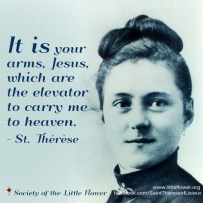 But she became one of the most popular, if not the most popular, saints of the twentieth century. Pope Pius XI made her the “star of his pontificate”. She was beatified in 1923, and canonized in 1925. Therese was declared co-patron of the missions with Francis Xavier in 1927, and named co-patron of France with Joan of Arc in 1944. On October 19, 1997 Pope John Paul II declared her the thirty-third Doctor of the Church, the youngest person, and at that time only the third woman, to be so honored. Devotion to Therese has developed around the world. Therese lived a hidden life and “wanted to be unknown”, yet became popular after her death. Today she is also the patron of florists; foreign missions; pilots; against tuberculosis; AIDS sufferers; illness; loss of parents; Australia; Russia; Diocese of Fairbanks, Alaska; Diocese of Fresno, California; Diocese of Juneau, Alaska; Diocese of Pueblo, Colorado, Nashik and many others.
What was so special about her? I think what made her popular was her down to earth spirituality which she proposed as a shortcut to holiness. She lived a very ordinary religious life in the nine years at the convent. There are no miracles, exploits or austerities recorded of her. She attained a very high degree of holiness by carrying out her ordinary daily duties with perfect fidelity, having a childlike confidence in God’s providence and merciful love and being ready to be at the service of others at all times. She also had a great love of the Church and a zeal for the conversion of souls. She prayed especially for priests.
Calm acceptance of Suffering
Therese had the spiritual courage of a real heroine. “May Jesus make me a martyr of the heart or of the body-or better, both!” she wrote. And she meant it. Apart from the inconveniences of weather which she bore joyfully there were other kinds of sufferings, too. She suffered a lot from bodily ailments. There were also nuns who made fun of or insulted her. But she would offer her pain to Jesus. She would hide her hurts under a smile. She told Jesus to do with her was his will. Sister Theresa tried hard to be humble. She called her method the “little way” to holiness.
Love of God
The year before Therese died, her sister Marie told her: “You are possessed by God, literally possessed, exactly as the wicked are by the devil.” Therese herself told Celine, her sister, I don’t believe I’ve ever been more than three minutes at a time without thinking of God.” Celine appeared to doubt this, whereupon Therese exclaimed: “Well, surely one thinks all the time of someone one loves dearly!” At her beatification Pius XI said, “Above all things Therese excelled in the love of God.” Her last words were, “Oh, I love Him” and “Dear God, I love You.”
Vocation to Love
Her intense love of God made her long for other vocations other than being a Carmelite at times. “I want to be a warrior, a priest, a n apostle, a doctor of the Church, a martyr…I would like to perform the most heroic deeds..….” These longings caused her intense suffering until she read and meditated on 1 Cor:13 where St Paul says that the most perfect gifts are nothing without charity. She says, “Charity gave me the key to my vocation. My vocation is love. in the heart of the Church, who is my Mother, I will be love.
Can we also be like her? Though she wanted to be a simple ordinary nun she was firm on one thing. Before entering the order she wrote to her sister Pauline, “I want to be a saint”. All what she thought, said and did were directed towards the achievement of this aim. It was to achieve this end that she developed her own little way. Today, if we are ready to take up her little way we too can march towards holiness.


 Vox Divini