“Don Bosco lived a pastoral experience in his first Oratory which serves as a model; it was for the youngsters a home that welcomed, a parish that evangelized, a school that prepared them for life, and a playground where friends could meet and enjoy themselves. As we carry out our mission today, the Valdocco experience is still the lasting criterion for discernment and renewal in all our activities and works” (C. 40)
- Introduction
The Valdocco Oratory brings us back to the original experience of the Salesian mission. Don Bosco, together with his collaborators and the first Salesians, embodied in the oratory that particular charism or experience of the Spirit who raised up in the Church our original form of apostolic mission among the poorest young people. So, today, in our seminar, referring to the Valdocco Oratory is not a historical exercise, simply looking back to what occurred there with Don Bosco as the Oratory at (C. 40) Hence, it is of utmost importance for us who are Salesians to capture the spirit of youth ministry with all its dynamism as it was present in the Oratory at Valdocco. It is the way for us to return to our origins, to the source that inspired our work and activities (cf. C. 41), and to verify the fidelity of our unique style of dealing with youth.
2. The Oratorian Heart
This return to our origins has as its goal the “oratorian heart,” which is characterised by a concern for the poorest youth and ordinary classes. This zeal is an expression of the salvific will of God embodied in the figure of the Good Shepherd, and it is directed first towards poor youth in the various forms of poverty in which they find themselves. we are to be faithful to the mission entrusted to us “to be signs and bearers of God’s love” (C. 2).
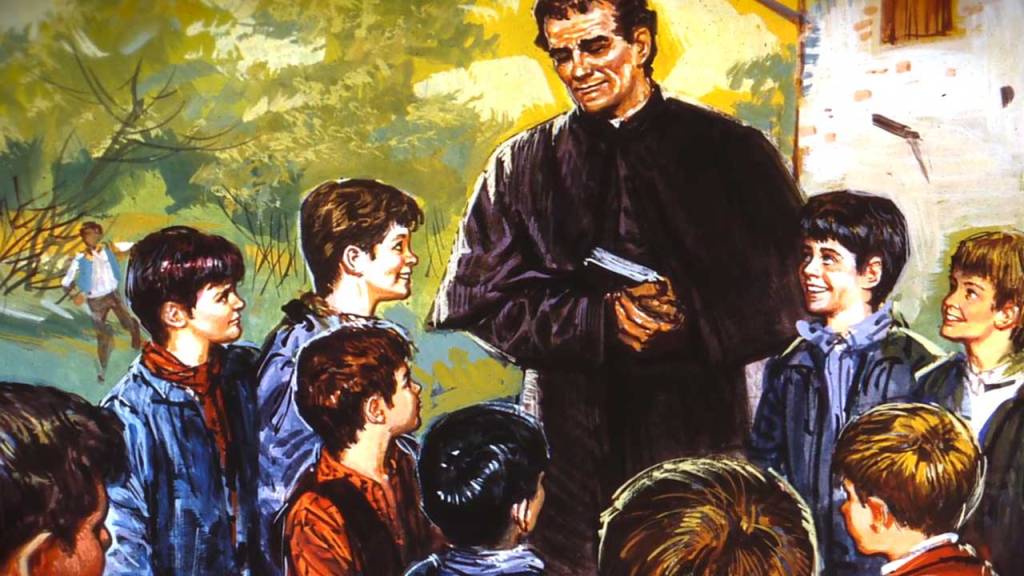
Secondly, in reference to the “oratorian heart,” we practice a typically Salesian educational method of sharing and communion which gives a specific style to our works. It is the heritage of the Salesian Family that consists not only in a wealth of experience at Valdocco but as an identity that results in a style. The practice of this method creates a family atmosphere and determines the initiatives that are necessary for each young person to grow in a warm and welcoming atmosphere (home) marked by happiness (playground), where he or she can develop all their potential, acquiring new skills (school) and embark on an explicit faith journey (parish).
The oratorian heart characterises our ecclesial charism, ensures the quality of our educational work and renews our pastoral activities, in line with the various cultural forms and with the various experiences of faith and religion in which young people live. It is not only the goal and form of Salesian educative-pastoral activity, but also becomes the fundamental criterion for discernment and renewal of our activities and works. If our work is to merit the description given by Don Bosco to his work, we must measure it, first of all, against Don Bosco’s own basic criteria which the Valdocco experience.
3. Four Aspects of Valdocco Experience
The most significant aspects of Valdocco oratory have been identified as home, parish, school and playground. These are images that do not indicate determined environments, spaces and places, but rather a series of experiences that are offered to the young. The diverse experiences of these four images add up to an indivisible and inseparable unity. It presupposes various forms of action in response to the youth situation, and therefore none of the four can be overlooked.
3.1 A Home that Welcomes (the Experience of Family Spirit)
The experience of “home” creates an environment of confidence and familiarity. As in a family it is essential that each member care for the others. In a Salesian environment this care is shown in many different ways and young people feel that they are listened to and understood. Values are transmitted through witness and accompaniment by educators who love and are loved. An unconditional welcome to young people when they arrive for the first time makes a huge impact. They are able to see that their most important needs are respected and that they are being offered an appropriate response.
The model for the Salesian “family spirit” is, in the first place, the life of the Oratory at Valdocco, where Don Bosco lived as a father among his boys and collaborators. The description given by the author of the Biographical Memoirs is memorable: “In those days the Oratory was truly a family”.[i] Don Bosco ran the Oratory as a large family, and the boys really felt as if they had never left their homes”. [1] Peaceful joy, unmarred by worry, ruled the Oratory, and family spirit brightened its life. The boys were given all the freedom compatible with discipline and good conduct”.[2] It was on this family style that Don Bosco set up all his houses, and even the religious community as well. There are a few points that we can imbibe from Valdocco oratory which can contribute to building of family spirit in our communities.
3.1.1 Co-responsibility for the Common Good
In a Salesian house there should be co-responsibility for the common good where the rules and regulations and duties are meticulously followed and accomplished under the force of love and not compulsion or force of authority. In such an atmosphere each one has ample space and freedom to take initiatives and carry out responsibilities proper to each one’s role in the Salesian community. The roles are not exercised in a compartmentalized form but in a flexible form without in anyway taking away the due place and role of another or without in any way escaping from one’s due responsibilities for the common good. There is a continuous flow of energy and good will towards one another in all situations.
3.1.2 Mutual Affection and Friendship
Salesian family spirit is the cultivation of mutual affection as in a family. Mutual affection, of feeling welcomed, wanted and accepted and loved, responsibility for the common good, i.e., of a deeply felt intercommunication is at the foundation of an authentic family spirit. Incorporation into the community brings with it the gift of brotherhood: this is something objective, perceptible by the light of faith, through which God gives Salesians to one another as a “brother to love” (cf. C50). Evidently this is not a matter of exclusively human friendship, but one which is born of the Lord’s gift (cf. also C 83).
Writing on 9 June 1867 to the Salesians at the Oratory, Don Bosco told them of his ideal that they should form ‘a family of brothers around their father’. Speaking more generally he said in 1873 that every rector ‘is a father who cannot fail to love his sons’… Family life among the confreres is the best way to ensure the same kind of life among the youngsters…
3.1.3 Family Spirit as the Best Ambience for the Exercise of Obedience
Within a family spirit atmosphere, the Salesian characteristics of obedience are described with the expressions dear to Don Bosco, taken in part from one of the articles of the Constitutions written by the Founder: “Let everyone be obedient to his superior, and consider him in everything as a loving father, obeying him without any sort of reservation, promptly, cheerfully and with humility”.[3] The force of charity reigning in the superior-subject relationship makes it all the more easy to obey and thus obedience becomes prompt, generous and unconditional availability for the common good and the mission. It becomes a ready, willing and cheerful obedience full of initiatives. Family spirit in which authority and obedience is exercised becomes the guarantee for the cohesion and continuity of the Congregation and become a sure path to holiness of life (art. 65).
3.1.4 Mutual trust and cordiality the ruling principle in every Salesian setting
Here too the principle extends to every kind of community in which Salesians are involved, because it is a feature of the spirit which they practise always and everywhere. The source of the principle is always the Letter from Rome, in which Don Bosco comes out with a kind of cry of anguish which is very significant: “In the old days at the Oratory, boys would do anything they were asked by one who they knew loved them. We had no secrets from you”, Valfré told Don Bosco. “Why do people want to replace love with cold rules?[4] In Salesian houses things are not done “because you have to”, but rather because the underlying reason is understood, because love and willingness are present, and all this in the light of faith.[5]
3.1.5 Air of Freedom and Creative Joy
One of the secrets of Salesian family spirit is the untroubled air of freedom and creative joy, which is common among the sons of Don Bosco. There is no constraint or fear, each one can say what he thinks, each one can make his own generous personal contribution and make suggestions. Don Bosco himself used to say: “God does not like things done by force. As a loving God, he wants things done for love’s sake”.[6]
3.2 A Parish that Evangelises (Religious Experience and Pedagogical Journey)
The experience of the “parish” is built on two main pillars: in the first place, the belief thatevery young person has in his or her heart the desire for God, the desire for a full life, the unifying perspective of faith; secondly, a series of initiatives suitable to young people, with the goal of helping them to discover and follow their vocation.
On this foundation our evangelising activity aims at creating an environment where faith is lived daily with spontaneity and normality. It is an environment where the essential dimensions of the Church are made explicit, according to the Salesian charism. This leads to communion. A key element is “Liturgy” or the Christian celebration of daily events. It reaches its highest point and fullest expression in the sacraments, especially in the Eucharist and Reconciliation. Another important element is Selfless service, far beyond ordinary assistance. Finally, there is witnessing the values of the Kingdom to the world in deeds of charity, with formative initiatives that prepare young people and educators to give a reason for the hope that is in them (1 Pet. 3:15-16).
Don Bosco gave to his meetings with the young the name of festive Oratory. ‘Oratory’ because as he saw it, its main purpose was spiritual and everything else was secondary.[7]Hence, Confession, prayers, Mass, explanation of the gospel, presentation of Bible history, catechism class, vespers, reciting the rosary, sermon on a virtue or vice, singing of litanies, the Benediction of the Blessed Sacrament were integral part of the Oratory experience for his boys at Valdocco. Particular emphasis was given to the sacrament of confession. Don Bosco had a particular knack of getting persons withdrawing from sacraments, especially confession, to taste the joy and freedom and relationship that come through that sacrament. These spiritual practices gave interior liberty to the boys and so they could joyfully enter into all other activities of the day and enter into warmer and freer and genuine relationship with staff and companions and live spontaneously in the presence of God.[8]
Oratory of Valdocco was a place where young people learned to relate with Jesus as a friend. In fact, the intensity of growth with constancy in spiritual life is seen when we begin to love Jesus intensely and develop a rapport of love, adoration, thanksgiving, reparation and apostolate in his honour.
In fact, Don Bosco presents the joy of spiritual life as a fruit of a soul empty of sin and full of God expressed in an intimate relationship with Jesus: He said: “If I have any problem, I take it to my confessor and he solves it for me according to what God wants. Jesus has said that the voice of the priest is the voice of God. If I have some particular need I go to Holy Communion in which I receive the body, blood, soul and divinity of Jesus which is broken for us. What more do I need to make me happy? Nothing in the wide world. Only one thing remains – one day to see revealed in heaven, him whom we can only see with the eye of faith here below”.
Let us talk briefly about Dominic Savio, Michael Magone and Francis Besucco with reference to their life of holiness at the Oratory.
3.2.1 Dominic’s Thirst for Holiness as an Act of Love for Jesus
Dominic’s thirst for holiness begins with his desire to give his entire being to Jesus totally: “I want you to help me to become a saint. I want to give up everything to Jesus and for always […]”.[9] This rapport finds its expression in his desire to keep his soul free of sin by going to confession and then receiving Jesus in the Holy Communion during the Eucharistic celebration and in his desire to speak to Jesus personally and also in the company of others by making a visit to the Blessed Sacrament in the tabernacle. Dominic’s days were full of happiness. He would go in ecstasy before Jesus in the Blessed Sacrament.[10]
3.2.2 The Desire of Magone for Jesus to be Born in his Heart
Michael Magone made his novena for the feast of the Immaculate Conception with great fervour and with ascetical and apostolic practices so that Jesus may be born in his heart:With similar fervour and recollection he celebrated the novena and feast of Christmas. “I really want to make every effort to make this novena well”, he said as he began it, “so that the Baby Jesus will come and be born in my soul with an abundance of His graces”.[11]
In order to strengthen the relationship of the oratory boys with Jesus, Don Bosco encouraged the establishment of the Blessed Sacrament Sodality and Michael Magone was an active member of it. The rules of the Sodality aimed at strengthening the relationship of the members with Jesus and to make them apostles who would bring others to Jesus and at the same time do reparation for the sins against Jesus in the Blessed Sacrament.[12]
3.2.3 Besucco and his Acts of Love for Jesus
Francis Besucco took delight in receiving Jesus in the Holy Communion and his heart was filled with joy in having Jesus in his heart and he continuously made acts of love to Jesus: He seemed to be ecstatic just after receiving Communion; his face changed colour and reflected the joy which filled his heart. The acts of love towards Jesus on such an occasion are proportionate to the care taken in preparing for Communion.[13]
3.3 A school that prepares them for life (holistic growth through education)
The experience of “school” is characterised by providing the resources necessary to ensure that every young person develops the skills and attitudes essential for life in society.
In every educational space, formal or informal, the educator must seek and find the way that leads to the welfare of each young person so that he or she can mature fully. The young person is the one who is first responsible for his or her own growth and maturity. The educator will accompany the young on their journey by offering them the experiences necessary for the harmonious development of their personality, in a way of life founded on respect and dialogue, for the formation of a critical conscience and a sense of commitment.
3.4 A playground to meet up with friends and be happy (the pedagogy of joy and celebration)
The experience of the “playground” is a natural environment where young people can form and deepen friendship and trust. The playground is understood as the place of education to happiness and joy. It encourages values and attitudes of confidence, anda suitable place for the care of each young person, for the little word in the ear, where the relationship between educator and young person helps to overcome the formalism associated with other structures, roles and environments. In Don Bosco’s words, “Here we make holiness consist in being cheerful. We try to avoid sin, which is the great enemy who steals God’s grace and peace of heart, to fulfil our duties exactly, and to be faithful to the practices of piety. Start today and write as a motto: ‘Servite Domino in laetitia’ – we serve the Lord in holy joy” (Life of St Dominic Savio, a pupil of the oratory of St Francis of Sales, chapter 18)
In this sense, the experience of the playground is a call to change from formal structures, and leave the walls within which we work, to make every place where we meet young people an environment rich in educational and pastoral proposals. It means a more decentralised approach, meeting young people in informal places such as the streets. The focus is not only on the personal relationship but also on enhancing the dynamics of informal groups. In the context of leisure activities, the new virtual meeting places and social networks are actually spaces where there are no strangers. We must be able to be present with the young wherever they meet.
4. The Letter from Rome: A Window into the Oratory at Valdocco
Don Bosco’s Letter from Rome is the magna carta of Salesian Spiritual Pedagogy. Don Bosco was in Rome on the business of the Salesian Society and other matters when he asked his secretary, Fr John Baptist Lemoyne to compose a letter based on an outline or sketch dictated to him by Don Bosco himself.
It was revived by Fr. Paul Albera, Don Bosco’s second successor and past pupil, on the occasion of the inauguration of the great monument to Don Bosco erected by the Salesian Past Pupils in the square in front of the Basilica of Our Lady Help of Christians, in 1920.
Recent research has revealed that the letter was needed; all was not well at Valdocco, discipline having become a serious problem with the senior students. The dream context of the letter is a familiar theme in the life of Don Bosco. Two of Don Bosco’s early Oratory boys appeared to him in a dream one evening as he was getting ready to retire for the night. The lengthy dialog that ensued contrasted in vivid detail the carefree and innocent years of the early Oratory with its then situation in the oratory. What had once been a home had now changed its nature. Don Bosco was quite shaken up by the experience and he hastened to put his encounter with Ferdinando Valfre and Giuseppe Buzzetti on paper while it was still fresh in his memory.
The letter reveals that the exemplary model for Salesian spirituality and pedagogy is the Valdocco Oratory. It exemplifies the Salesian spirit: presence, rapport, joy and optimism, expansive expression of life. The family atmosphere is governed not so much by recourse to rules as by faith and the promptings of the heart. The atmosphere in a Salesian house is qualified by “mutual trust” and “daily forgiveness”. The Letter of Don Bosco from Rome to his Salesians at Valdocco endorses this. The first Oratory at Valdocco is described thus: “The greatest cordiality and confidence reigned between youngsters and superiors … closeness led to affection and affection brought confidence. It is this that opens hearts and the youngsters express everything without fear to their superiors”. And then, when things had changed at the Oratory: “The reason for the present change is that many of the boys no longer have confidence in their superiors…, who are now thought of precisely as superiors and no longer as fathers, brothers and friends… If you want everyone to be of one heart and soul again, for the love of Jesus you must break down this fatal barrier of mistrust and replace it with a happy spirit of confidence”.[14] Brotherly relationships and mutual trust make recourse to laws, regulations, norms and authority less necessary; instead appeal is made to interior qualities of the individual, to faith and the “promptings of the heart”.
5. Conclusion
Let me conclude with a quote from Fr. Juan Vecchi Says, “When we think of the origin of our Congregation and Family, we find first of all a community, which was not only visible, but indeed quite unique, almost like a lantern in the darkness of night: Valdocco, the home of a novel community and a pastoral setting that was widely known, extensive and open … Such a community gave rise to a new culture, not in an academic sense but in that of a new style of relationship between youngsters and educators, between laity and priests, between artisans and students, a relationship which had its effect on the area and on the city itself … All this had as its root and raison d’etre the faith and pastoral charity, which tried to create from within a family spirit, and led to a deep affection for God and our Lady”
[1] BM IV, 474.
[2] BM IV, 338-339.
[3] Constituzioni 1875, III, 2 (cf. F. MOTTO, 93).
[4] Ibid.
[5] V. Don Caviglia’s description of the fatherly authority of Don Bosco: A. Caviglia, Don Bosco, 168-169.
[6] BM VI, 637.
[7] WORTH, Don Bosco and His Salesians, 17.
[8] MO 266-267.
[9] DS Ch. 10, 14.
[10] DS Ch. 20, 34-35.
[11] DS Ch. 13, 22.
[12] MM Ch. 13, 23, footnote.
[13] FB Ch. 12, 15.
[14] Letter from Rome, 10 May 1884; cf. Appendix to 1984 Constitutions, 254-264.
[i] BM III, 250


 Vox Divini