On May 9, 2025, Archbishop Joseph Pamplany of the Syro-Malabar Archdiocese of Tellicherry announced that the Vatican had officially recognized a Eucharistic miracle that occurred on November 15, 2013, at Christ the King Church in Vilakkannur, a small village in Kerala’s Kannur district. The formal declaration of this recognition took place on May 31, 2025, led by Apostolic Nuncio Archbishop Leopoldo Girelli during a Mass attended by over 10,000 people, marking a significant moment for the Syro-Malabar Church and the global Catholic community. This event has deepened Eucharistic devotion among the faithful. This article explores the history, background, investigation, and significance of the Vilakkannur Eucharistic miracle, drawing exclusively from verified sources.
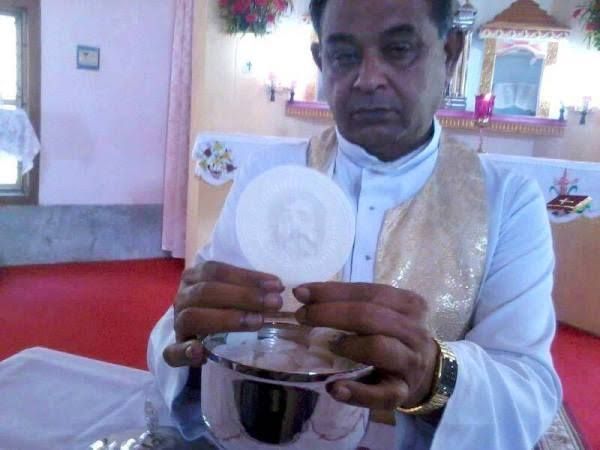
The Event: November 15, 2013
On November 15, 2013, during a morning Mass at Christ the King Church in Vilakkannur, Father Thomas Pathickal, the parish vicar at the time, elevated the consecrated Host during the Eucharistic Prayer. As he did so, he noticed an unusual spot on the Host, which gradually took the form of a human face, identified by witnesses as resembling the face of Jesus Christ. The phenomenon caused a profound reaction among the congregation, who knelt in awe and reverence. Father Pathickal, taken by surprise, set the Host aside for further examination, and news of the event quickly spread beyond the parish.
The appearance of the face was not fleeting; it remained visible, prompting thousands of pilgrims to flock to the remote village, approximately 50 kilometers east of Kannur town. The influx of visitors was so significant that it blocked roads leading to Paithalmala, a nearby tourist destination, requiring intervention from local police and district officials to manage the crowds. Photographs of the Host went viral on social media, further amplifying public interest.
Historical and Cultural Context
Vilakkannur is a rural parish under the Syro-Malabar Archdiocese of Tellicherry, established in 1962. The parish serves over 500 families, approximately 1,250 Catholics, many of whom are descendants of second- and third-generation migrants from central Kerala. The Syro-Malabar Church, one of the 23 Eastern Catholic Churches in communion with Rome, has a rich tradition rooted in the apostolic legacy of St. Thomas the Apostle, who is believed to have brought Christianity to India in the first century. This cultural and religious heritage provides a backdrop for the deep Eucharistic devotion characteristic of the community, which likely contributed to the significance placed on the 2013 event.
Eucharistic miracles hold a special place in Catholic theology, serving to reaffirm the doctrine of transubstantiation—the belief that the bread and wine become the Body and Blood of Christ during the Mass, despite retaining their physical appearances. Unlike other well-known Eucharistic miracles, such as those in Lanciano (Italy, 8th century) or Buenos Aires (Argentina, 1990s), which often involve bleeding Hosts or transformations into human tissue, the Vilakkannur miracle is distinct for its gentle manifestation: a radiant human face appearing on the Host without blood or tissue. This phenomenon echoes the spiritual experience of the Emmaus disciples, whose “hearts burned within them” upon recognizing Christ (Luke 24:32).
The Investigation Process
The Catholic Church approaches claims of miracles with rigorous scrutiny to distinguish genuine supernatural events from natural phenomena or fraud. Following the 2013 incident, the Archdiocese of Tellicherry took immediate steps to investigate. A three-member team was dispatched to study the phenomenon, and the Host was transferred to the archdiocesan headquarters for safekeeping and further examination. The Church initially cautioned against premature publicization, emphasizing the need for thorough discernment.
In September 2018, the Host was returned to Christ the King Church for public veneration, placed on a side altar as a “Relic of Divinity,” as declared by the Syro-Malabar Church’s Theological Commission after a detailed study. However, the archbishop at the time, Mar George Njaralakatt, clarified that this did not constitute official recognition as a Eucharistic miracle, and the Host was not to be used for Eucharistic Adoration or placed on the main altar. The parish was also instructed to document any signs or supernatural occurrences related to the Host for further study.
In January 2020, the Host was sent to Rome for additional scientific and theological analysis. On January 10, it was taken to the Syro-Malabar Church’s headquarters in Kakkanad, Kochi, and handed over to Apostolic Nuncio Archbishop Giambattista Diquattro during the Syro-Malabar Synod (January 7–15). The Host underwent further examination, including a study at Bangalore Christ University on January 23, 2024. The investigation concluded that the image was formed by the same substance as the Host, with no trace of foreign materials, ruling out tampering or natural explanations such as mold or bacteria. On March 19, 2025, the Congregation for the Doctrine of the Faith in Rome, via the apostolic nuncio, informed the Archdiocese of Tellicherry that there was no impediment to declaring the event an extraordinary Eucharistic sign.
The Vatican’s recognition was formally announced by Archbishop Joseph Pamplany on May 9, 2025, during a ceremony at Christ the King Church. The official declaration occurred on May 31, 2025, led by Apostolic Nuncio Archbishop Leopoldo Girelli during a Mass attended by over 10,000 people, including several bishops and archbishops emeritus. The Host was carried in a procession and installed for veneration, marking the culmination of a 12-year investigation.
The Vatican’s Role and Criteria
The Catholic Church’s process for approving Eucharistic miracles is meticulous, involving both scientific and theological scrutiny. The local bishop typically initiates the investigation, appointing a team of experts, including priests, theologians, canon lawyers, and scientists (often medical professionals or molecular biologists). The scientific team verifies the chain of custody and ensures no preservatives or contaminants explain the phenomenon. The theological commission ensures the event aligns with Church doctrine, particularly the teaching of transubstantiation. While the local bishop has the authority to declare a miracle, the Vatican may be consulted for significant cases, as occurred in Vilakkannur.
In this case, the Vatican’s Congregation for the Doctrine of the Faith reviewed the findings and determined that the event was “worthy of belief,” a designation indicating that it could inspire faith without contradicting doctrine. Unlike miracles associated with canonizations, which require strict criteria (e.g., instantaneous healings with no natural explanation), Eucharistic miracles are evaluated to strengthen belief in the Real Presence of Christ in the Eucharist. The Vilakkannur miracle’s approval aligns with this purpose, as it has been credited with increasing Eucharistic devotion, vocations, and personal conversions in the parish.
Significance and Impact
The Vatican’s recognition of the Vilakkannur miracle has profound implications for the Syro-Malabar Church and the broader Catholic community. Archbishop Leopoldo Girelli, during the May 31, 2025, declaration, emphasized that the miracle is a call to unity within the Syro-Malabar Church, which has faced internal liturgical disputes over the orientation of the priest during Mass. He described the Eucharist as a “symbol of unity and charity,” urging the faithful to overcome divisions and deepen their communion with God. The miracle is seen as a blessing not only for the Syro-Malabar Church but for the entire Church in India, reinforcing its apostolic zeal and missionary vitality.
Locally, the miracle has transformed Christ the King Church into a pilgrimage site. Since 2013, thousands have visited to venerate the Host, reporting personal blessings and spiritual renewals. Father Mathew Paravarakath, the current parish priest, expressed joy at the Vatican’s recognition, noting that it has strengthened the community’s faith in the Eucharist and its role as a global witness to Christ’s presence. The event has also drawn comparisons to other recognized Eucharistic miracles, such as those in Lanciano, Bolsena (1263), and Sokółka (2008), though its unique manifestation—a radiant face without blood or tissue—sets it apart as a gentle yet powerful sign.
Challenges and Skepticism
While the Vatican’s approval lends credibility, Eucharistic miracles often face skepticism, even among Catholics, who are not required to believe in specific miracles as a matter of faith. Some critics highlight the possibility of fraud, noting that imprinting an image on bread could be achieved through human means. The Church counters this by emphasizing its rigorous investigative process, which includes independent scientific analysis to rule out natural explanations like red bread mold (Neurospora crassa) or bacteria (Serratia marcescens). In Vilakkannur, the absence of foreign materials and the Host’s unchanged substance after 12 years of study bolster the case for its authenticity. Nonetheless, the Church encourages discernment, leaving the faithful free to interpret the event as a sign of divine presence or a call to deeper faith.
Conclusion
The Eucharistic miracle of Vilakkannur, recognized by the Vatican in 2025, stands as a testament to the Catholic belief in the Real Presence of Christ in the Eucharist. From its occurrence on November 15, 2013, to its formal declaration on May 31, 2025, the event has undergone extensive scrutiny, involving scientific studies, theological reviews, and Vatican oversight. Its recognition affirms the faith of the Syro-Malabar community and invites Catholics worldwide to reflect on the mystery of the Eucharist. As a “Relic of Divinity,” the Vilakkannur Host continues to inspire devotion, unity, and spiritual renewal, echoing the words of Pope St. John Paul II, who called the Eucharist the “radiant sign of the Face of Christ.”
For those wishing to visit, the Host is venerated at Christ the King Church in Vilakkannur, though specific details on timings and access should be confirmed with the parish or the Archdiocese of Tellicherry.


Thank you so much fr for the information.
*God Bless you *
With Regards * *Sr. Eva Kharkrang MSMHC
LikeLiked by 1 person