Growing in holiness is a lifelong journey of growing in conformity with Christ. It is a path that invites us to be inserted into the very life of the Holy Trinity where we participate in divine communion through grace. This process, known as theosis or divinization, allows us to share in God’s nature while remaining His creatures, as affirmed in Scripture: “that you may become partakers of the divine nature” (2 Pet 1:4). St. John of the Cross, in his work The Living Flame of Love, describes this union as the soul being transformed by God’s love, becoming a “living flame” that mirrors the divine fire of the Trinity, emphasizing the soul’s ascent through purification and love. The “Triangle of Growth” provides a visual and practical guide for this journey, illustrating a systematic approach to holiness.
This ordering of life before God, as exemplified by King Jotham in 2 Chr 27:6—“So Jotham became strong because he ordered his ways before the Lord his God”—is the foundation of spiritual growth. Enabled by grace and sustained by personal effort, we are called to cultivate a vibrant communion with the Lord, bearing fruit for His kingdom. As 2 Pet 1:5-7 urges, “you must make every effort to support your faith with goodness, and goodness with knowledge, and knowledge with self-control, and self-control with endurance, and endurance with godliness, and godliness with mutual affection, and mutual affection with love.” The “Triangle of Growth” image captures this sacred journey, guiding us through three interconnected practices that foster holiness and deeper union with God.
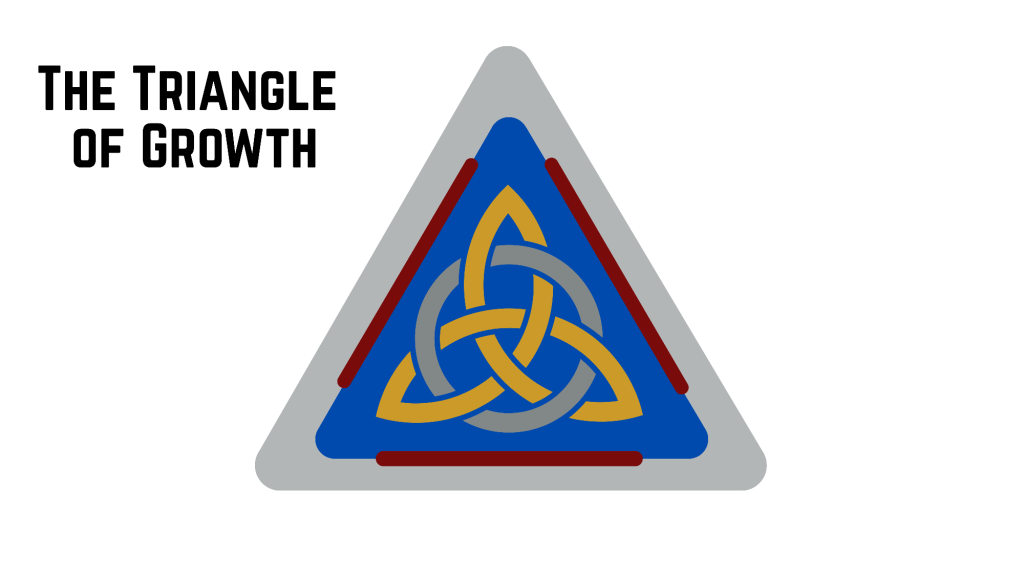
Symbols of Divine Union and Transformation
Trinitarian Triangle: The Triangle of Growth image features a yellow Trinitarian triangle at its center, representing the Holy Trinity—Father, Son, and Holy Spirit—in perfect unity. Its yellow hue reflects the radiant glory and divine light of God, inviting the soul into His eternal life.
Human Circle: Within this triangle lies a gray, interwoven human circle, depicting the soul being embraced by the Trinity. The gray color signifies our imperfection due to the faded image of God in us, yet growing into the perfect image of God as we are transformed. The full circle shows the completeness of human nature within the Trinity, echoing Jesus’ words: “that my joy may be in you, and that your joy may be complete” (Jn 15:11).
Blue Triangle: A blue triangle surrounds the Trinitarian triangle, symbolizing God’s grace. Blue, favored since the twelfth century for its luminosity in stained glass, represents divine light and heaven, often associated with the Virgin Mary. Here, it also signifies the saints in heaven—already inserted into the Trinity, ever in God’s presence, and interceding for us on our journey.
Gray Triangle: The gray triangle represents the human being created in the image and likeness of God, mirroring the Trinitarian form. Its gray color reflects human fragility and the faded image of God within us, dimmed by the illusions of the evil one. But it is capable of being restored through divine grace and spiritual growth (circle within the trinitaruan triangle).
Three Red Bars: The three red bars represent the spiritual practices of Spiritual Fencing, TAPPING, and Vox Divini Meditation, connecting the gray triangle with the blue one. These practices help to bridge the outer gray triangle of human fragility to the divine life. The red color symbolizes the need to die to self, a sacrificial act that aligns the soul with God’s will. These practices enable one to touch heaven while standing on earth, as the Book of Wisdom suggests (Wis 18:16).
The Three Practices: A Shield for the Journey
The journey toward holiness is shielded by three interconnected practices: Spiritual Fencing, TAPPING, and Vox Divini Meditation, which form a dynamic triangle of growth. Spiritual Fencing guards the soul by consciously aligning thoughts with Christ, protecting against distractions and temptations. TAPPING restores communion with God by surrendering daily failures and repairing breaches in our spiritual defenses. Vox Divini Meditation plants and nurtures the seeds of holiness, deepening our union with Christ through systematic stages of meditation. Together, these practices ensure a disciplined, grace-filled path to the heart of the Trinity.
Spiritual Fencing: A Discipline Rooted in Communion
Spiritual Fencing is more than mere discipline; it is a sacred practice of consciously occupying the mind, turning every thought into a conversation with Christ, rooted in our communion with the Lord. Like a gardener who builds a sturdy fence to protect a vegetable garden from animals or careless visitors, Spiritual Fencing shields our inner life from distractions, temptations, and worldly influences that threaten spiritual growth. It requires constant vigilance—monitoring our thoughts and redirecting them to Christ when they stray—lest external forces, such as idle musings or sinful inclinations, invade and trample the seeds of faith, as Jesus illustrates in Mt 13:4, where seeds on the path are eaten by birds, leaving the ground hardened and unresponsive to God’s word.
TAPPING: Restoring Communion and Repairing the Fence
Even with Spiritual Fencing, we will stumble, as sin breaches our defenses and creates gaps in our communion with God, much like Adam and Eve who “hid themselves from the presence of the Lord God” after their sin (Gen 3:8), overcome by fear and shame. TAPPING is the remedy—a daily practice of surrendering our failures to God and washing them in the blood of Jesus, swiftly restoring our communion with the Lord on the day we fail, without waiting for sacramental confession. We should resolve to make confession at the nearest opportunity we get. So our growth continues uninterrupted, as 1 Jn 1:7 assures: “If we walk in the light as he himself is in the light, we have fellowship with one another, and the blood of Jesus his Son cleanses us from all sin.”
Vox Divini Meditation: Planting and Nurturing the Seeds of Holiness
Spiritual Fencing and TAPPING create the conditions for growth, but without planting and tending seeds, the garden of the soul remains barren. Vox Divini Meditation ditation is the systematic practice of growing in conformity with Christ through stages—Foundational, Advanced, Contemplative, and Unitive—deepening our union with Him and bearing fruit for His glory. Like a gardener who weeds, waters, and nurtures plants, Vox Divini Meditation requires regular care to produce the fruits of the Spirit: love, joy, peace, patience, kindness, generosity, faithfulness, gentleness, and self-control (Gal 5:22-23), ensuring that our spiritual journey yields a harvest of holiness that reflects Christ’s image.
The Interconnected Triangle of Growth
Spiritual Fencing, TAPPING, and Vox Divini Meditation form an inseparable triangle, each practice reinforcing the others to cultivate holiness. TAPPING is like a person in charge to repair the fence if it’s broken, because if we remain without repair, the more we delay, the deeper our struggles become, allowing distractions to take root. Vox Divini Meditation represents the seeds that are growing, nurtured to bear the fruits of the Spirit in our lives. Neglecting Spiritual Fencing leaves our minds vulnerable, like the path in Mt 13, where seeds are snatched away, halting growth. Without TAPPING, breaches in our communion with God go unmended, stunting our spiritual progress and deepening our struggles. Without Vox Divini Meditation, we have a protected garden but no seeds to grow, rendering our efforts fruitless. Together, these practices, supported by the grace of God and the intercession of the saints, guide us toward the heart of the Trinity, enabling us to live a disciplined, orderly life that fosters a vibrant communion with the Lord and conformity with Christ.



 Vox Divini