In the journey of Spiritual progress , the transition from active human effort to divine absorption is the most volatile, confusing, and painful territory a seeker will ever cross. While many spiritual frameworks treat growth as a linear path of increasing peace, classic mystical theology—most notably articulated by St. Teresa of Avila in her masterpiece The Interior Castle—reveals that true spiritual maturation involves structural crises.
To map this journey, we categorize the spiritual life into four distinct, progressive stages of illumination.
At the Foundational Level, a person wrestles with external behaviour, builds basic moral boundaries, and learns to rise quickly after a fall, using analytical self-evaluation to reduce the frequency of those failures.
This is the landscape of Prov 24:16: “For though the righteous fall seven times, they rise again.” It is also mirrored in the early life of King David, who, when confronted with his failures, immediately repented, faced the structural consequences, and re-established his moral boundaries (Ps 51).
However, once these foundational habits become second nature, the soul passes an invisible threshold into Level 2: The Awakened Level (corresponding roughly to the Fourth and Fifth Mansions of the Interior Castle). This level represents the absolute peak of ascetical theology—the maximum threshold that a human being can possibly reach by intentionally cooperating with ordinary grace. It is a profound, paradoxical zone where intense spiritual delights and crushing psychological dryness exist side by side.
This transition into the Awakened Level is heavily anchored in the New Testament, which frequently command the soul to break out of spiritual lethargy and enter active cooperation with grace. It is the literal realization of Eph 5:14: “Wake up, sleeper, rise from the dead, and Christ will shine on you.” It also mirrors the critical apostolic warning in Rom 13:11: “And do this, understanding the present time: The hour has already come for you to wake up from your slumber, because our salvation is nearer now than when we first believed.” To be “Awakened” means the illusions of the outer world have cracked, forcing the human will to fully mobilize its faculties for the interior journey.
1. The Core Dynamics of the Awakened Level
The Awakened Level is defined by a radical shift in spiritual physics. In the foundational stage, spiritual progress requires a great deal of external management. In the Awakened stage, the soul’s centre of gravity implodes inward.
The Dawn of Interior Migration
For the first time in the seeker’s life, a true internal migration takes root. The soul begins to behave like a hedgehog or a turtle, instinctively drawing its senses, thoughts, and faculties away from the external world and pulling them toward the hidden centre of the self. This is not a forced mental exercise; it is a response to a magnetic pull emanating from the deepest chamber of the soul.
This internal migration fulfills the profound directive of Lk 17:21: “The kingdom of God is within you.” It is illustrated beautifully by Elijah in 1 Kgs 19. He looked for God in the great and powerful wind, in the earthquake, and in the fire—all external, sensory phenomena—but God was not in them. Elijah had to migrate inward to encounter God in the kol demamah dakkah—the “still, small voice” or the “sound of sheer silence.”
The Retreat from “Too Much Talking”
As this internal migration intensifies, the seeker develops a natural, spontaneous distaste for superficial chatter and empty social performance. The psychological reason is structural: the mind is preoccupied with an internal guest.
- The soul realizes that a vast majority of human speech is driven by the ego—defending oneself, projecting an image, or managing impressions.
- Having lost interest in these ego-driven games, words begin to feel incredibly heavy and clumsy.
- This is a transition from dissipation (scattering spiritual energy through talk) to recollection (gathering energy in silence). Speech becomes condensed, deliberate, and weighted with substance.
Biblical Insight: This movement embodies Eccl 5:2: “Do not be quick with your mouth, do not be hasty in your heart to utter anything before God. God is in heaven and you are on earth, so let your words be few.” We see this perfectly in Zech (the father of John the Baptist) in Lk 1. To prepare his soul for the supernatural birth of the herald of Christ, God struck him mute. His forced external silence created the exact internal cocoon necessary to move from skepticism to an awakened, prophetic song of praise.
2. From External Law to Internal Love: The Shift in Control
A critical, definitive marker of the Awakened Level is the total collapse of legalism. At this stage, the seeker is no longer controlled or motivated by external rules, regulations, or religious checklists.
In the Foundational stage, the soul relies heavily on External Control—doing or not doing certain things out of duty, fear of punishment, or a rigid desire to match a “holy” profile. In the Awakened Level, this mechanics shifts entirely to Internal Control. The soul is governed completely by a personal, consuming love for God. You no longer avoid unhelpful behaviors because a rulebook explicitly forbids them; you avoid them because your heart is so deeply captivated by the Divine presence that the very thought of disrupting that quiet intimacy causes intense grief. Virtue ceases to be a forced obligation and becomes a spontaneous necessity of love.
This shift is the literal fulfillment of the New Covenant promised in Jr 31:33: “I will put my law in their minds and write it on their hearts.” It is also beautifully demonstrated by the Apostle Paul in Gal 5:18, where he states, “But if you are led by the Spirit, you are not under the law.” The Awakened soul has moved past the elementary, external guardrails of religious rules because it is now driven from within by the internal gravity of the Holy Spirit.
3. The Paradox of Coexisting Delight and Dryness
The most confusing aspect of the Awakened Level is the simultaneous experience of intense spiritual intimacy and devastating interior desolation. Seekers often assume they are backsliding when they enter this zone, but they are actually advancing.
To understand this paradox, we must look at the mathematical and structural realities of grace operating on different layers of the human psyche. Let spiritual progression be a function of human cooperation and divine grace. At the Awakened Level, human effort hits its absolute maximum capacity, cooperating intensely with a deeper, illuminating grace.
Because this intense light enters a vessel that is still structurally imperfect, it splits the seeker’s experience into two distinct psychological layers:
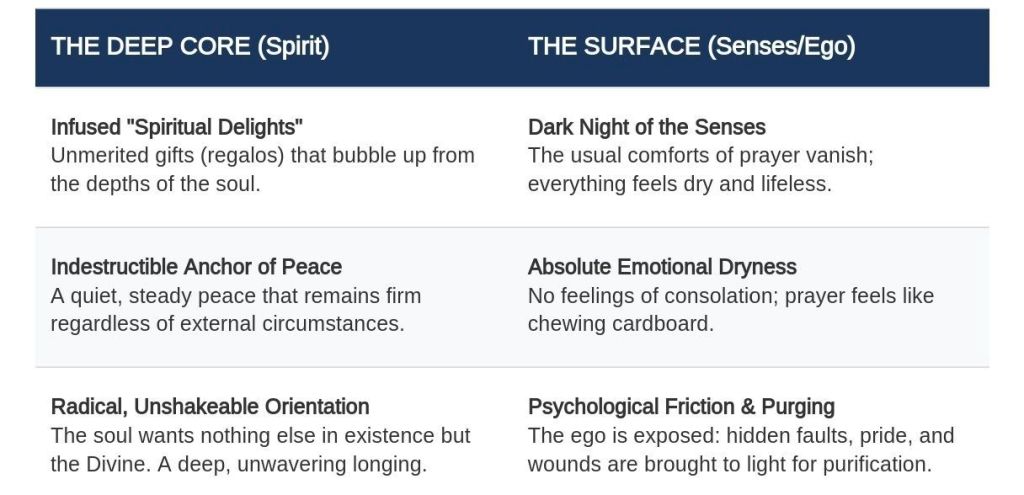
The Deep Core: Spiritual Delights
At the root of the soul, God pours in what St. Teresa calls Spiritual Delights (regalos). Unlike the “contentments” of the foundational level—which are merely pleasant emotional feelings resulting from our own successful self-discipline—these delights bubble up unearned from the absolute depths of the spirit. It is an subterranean, indestructible anchor of peace and a quiet conviction that the soul wants nothing else in existence but the Divine.
This deep core delight is what Jeremiah experiences when he writes: “Your words were found, and I ate them, and your words became to me a joy and the delight of my heart” (Jr 15:16). It is the hidden water Jesus promises to the Samaritan woman in Jn 4:14—a spring welling up from within, independent of external jars or buckets.
The Surface: Crushing Dryness and the Pain of Distance
While the deepest spirit tastes this quiet delight, the shallower layers of the psyche—the emotions, the imagination, and the ego—are thrown into total darkness. This is the onset of what St. John of the Cross terms the Passive Night of the Senses.
The ego is systematically starved of its usual comforts. Prayer, which used to feel emotionally warming, suddenly feels like chewing cardboard. The imagination runs wild like a frantic animal, creating immense internal friction. Furthermore, because the divine light is shining so brightly into the interior, the seeker suddenly sees their deepest, hidden miseries—their need for control, their subtle spiritual pride, and their psychological defense mechanisms—with terrifying clarity. It’s also a stage where you become aware of your deep seated ‘non integrated needs’ that control you from your subconscious mind.
The Floodlight Effect: If you walk into a dim room with a small candle, the room looks relatively clean. If you turn on a massive, brilliant floodlight, you suddenly see every speck of dust, mold, and cobweb. Because the Awakened soul is exposed to this brilliant divine light, it feels incredibly dirty and profoundly distant from God, even though it is actually closer to Him than ever before.
No book captures this simultaneous delight and dryness better than the Song of Solomon. In Songs 5:2-6, the bride’s heart is completely awakened—she says, “I slept, but my heart was awake. Listen! My beloved is knocking.” This is the deep core delight. Yet, the moment she opens the door, her beloved has vanished: “I opened to my beloved, but my beloved had turned and was gone. My soul failed me when he spoke. I sought him, but I could not find him; I called him, but he gave no answer.” She is consumed by the agonizing pain of distance, searching the dark streets, feeling completely abandoned, even though her entire search is driven by an intense, awakened love.
We see the “Floodlight Effect” perfectly in the prophet Isaiah (Is 6:5). When he is pulled into the heavenly temple and sees the brilliant glory of God, his immediate reaction is not emotional happiness. Instead, the intense light exposes his hidden unworthiness, causing him to cry out in pain: “Woe to me! I am ruined. For I am a man of unclean lips!”
4. The Evolution of Prayer inside the Awakened Level
As a person moves through the Awakened Level, their method of communication with the Divine undergoes a profound structural evolution. The soul can no longer tolerate discursive meditation (using books, arguments, or complex mental images). The intellect is tired of analyzing about God; it wants to look directly at God.
The prayer life typically progresses through three distinct phases:
Phase A: The Refusal of Discursive Thought
If the seeker attempts to pick up a book to follow a complex theological argument or a structured mental guide during prayer, the mind actively rebels. The intellectual machinery of the ego begins to shut down, rendering analytical reading dry and unprofitable.
Phase B: The Prayer of Active Recollection
This is the highest form of prayer the soul can produce by its own deliberate choice. Drawing on the senses, the soul intentionally shuts the doors to the external world. Like a shepherd calling sheep back to the fold, the seeker gathers their wandering thoughts and encloses them within the heart. It takes real, ascetical effort to hold the mind steady using a single sacred word or focus, but it yields a deep, protective boundary around the interior life.
This is the active fulfillment of Jesus’ command in Mt 6:6: “But when you pray, go into your room, close the door and pray to your Father, who is unseen.” In the Awakened Level, the “room” is no longer just a physical space; it is the inner chamber of the heart, and “closing the door” is the active shutting out of sensory distractions.
Phase C: The Prayer of Simplicity (Acquired Contemplation)
As active recollection matures, it softens into a state of silent, loving awareness. The multiple frantic acts of the mind are reduced to a single, simple gaze.
It is perfectly mirrored by the psychological analogy of an old couple who have been happily married for fifty years: sitting together on a porch in the evening, they do not need to speak, nor do they need to think new, complex thoughts about one another. They simply sit in each other’s presence, fully aware, deeply content, anchored entirely by a quiet, shared gaze.
This silent, loving gaze is beautifully illustrated by Mary of Bethany in Luke 10:39, yet its mechanical reality is often misunderstood. We often pit Mary against her sister Martha, assuming that the Awakened Level requires us to sit physically frozen in a room without doing practical work. This is a mistake.
The core issue with Martha was not that she was active or serving—external labor is a holy and necessary part of life. The issue was that her activities were accompanied by an internal friction; she was anxious and worried, and that internal noise was fracturing her attention and pulling her away from the Lord. If Martha had been able to engage in that exact same house management with a quiet, recollected mind, free from anxiety, her active serving would have been a perfect expression of an awakened life.
Therefore, entering the Awakened Level does not mean you stop doing your job, cooking meals, or fulfilling responsibilities; rather, it means you train your mind to remain anchored in the “one thing necessary”—the internal gaze at the Guest within—even while your hands are busy working in the external world. It is the lived reality of Ps 131:2: “But I have calmed and quieted myself, I am like a weaned child with its mother; like a weaned child I am content.” The child is quieted within, completely independent of whatever external motion is happening around it.
5. The Threshold of Death: Moving to the Contemplative Level
The grand paradox of the Awakened Level is that you pass through it by failing.
Because the Awakened Level is the absolute limit of human capacity, the soul must eventually run full speed into its own psychological ceiling. You can clean the vessel, you can quiet your speech, you can anchor your mind in active recollection, but you quickly realize that you cannot make the Divine appear. You cannot force a supernatural mystical experience.
This realization utterly breaks the final, most stubborn layer of human corruption: spiritual pride. The soul realizes its complete helplessness.
The Analogy of the Silkworm
To describe this definitive transition from the Awakened Level to the Contemplative Level, we can use a metaphor of the silkwarm that St. Teresa uses in the Fifth Mansion to describe the spiritual journey of a soul.
- Feeding on the Mulberry Leaves: The Foundational Level: Gathering virtues, practicing discipline, and reading the scriptures.
- Spinning the Cocoon: The Awakened Level: The interior migration, moving away from excess talking, and building the cell of solitary prayer.
- The Death of the Worm: The Threshold of Transition: Realizing the total insufficiency of human effort, surrendering all control, and entering complete psychological stillness.
- The Emergence of the Butterfly: The Contemplative Level: The soul is supernaturally transformed and lifted into a realm beyond its own capacity.
The silkworm must carefully spin its cocoon through good works, penance, and interior migration. It builds its own cell of isolation. But once that cocoon is fully built, the silkworm must die. This death means the absolute surrender of the active faculties. You must become completely still, empty, and helpless.
Biblical Insight: This necessity of death before supernatural transformation is the core thesis of Jesus in Jn 12:24: “Very truly I tell you, unless a kernel of wheat falls to the ground and dies, it remains only a single seed. But if it dies, it produces many seeds.”
The construction of the cocoon followed by total helplessness is perfectly mirrored by the Apostle Paul in Rom 7 and 8. Paul reaches the absolute peak of his own human striving under the law (the Awakened Level), yet he finds himself completely paralyzed by his internal brokenness, crying out in total exhaustion: “What a wretched man I am! Who will rescue me from this body that is subject to death?” (Romans 7:24). Only when he completely dies to his own capacity does he drop into the effortless, infused life of the Spirit in Romans 8, where he notes that when we are too weak to even know how to pray, the Spirit Himself takes over and intercedes for us (Rom 8:26).
5. The Infused Lift
When the soul has been thoroughly “cooked” in the crucible of the Awakened Level—having quieted its tongue, anchored its gaze, and completely surrendered its own capacity to save or elevate itself—the mechanics of the spiritual life shift from Acquired states to Infused states.
The Lord steps into the empty cocoon. Recognizing that the human being has gone as far as human legs can walk, the Divine lifts the soul into
Level 3: The Contemplative Level.
A Journey of Deepening Surrender. From human effort in ‘drawing water’ to God-given transformation in ‘receiving rain’.
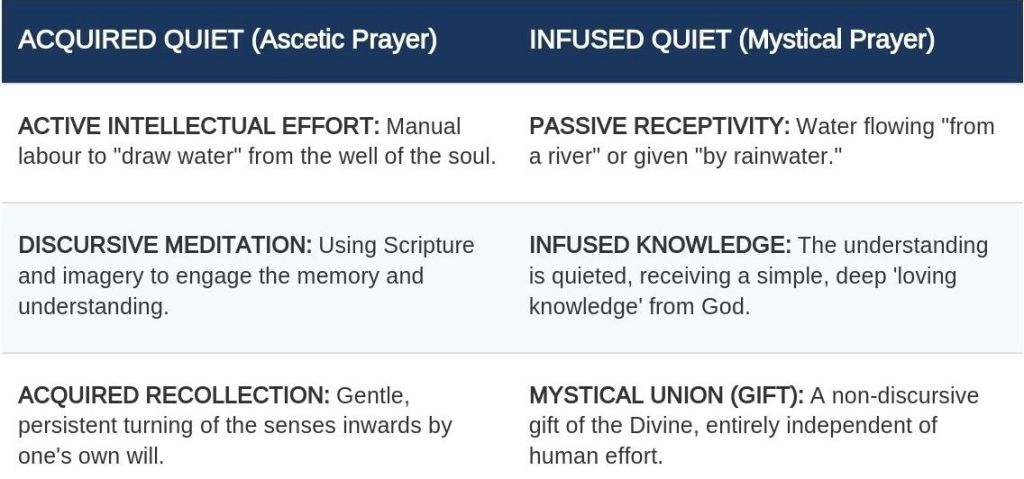
In this transition to Infused Contemplation, the intellect, the wandering imagination, and the defensive ego—which you fought so bitterly to control throughout the Awakened Level—are suddenly, effortlessly put to sleep by God Himself.
You no longer have to struggle to keep your mind from wandering; the Divine presence becomes so profoundly magnetic that the psyche is held perfectly still without an ounce of human labor. The active work of the human being is over; the supernatural work of the Divine has begun.
This transition from human struggling to divine lifting is beautifully illustrated by the crossing of the Red Sea in Ex 14:13-14. The Israelites are backed into a corner, having run as far as their legs could carry them. They can do nothing more. Moses gives them the ultimate rule of Infused Contemplation: “The Lord will fight for you; you need only to be still.”
We see it also in Eze 37 with the vision of the valley of dry bones. The bones are completely stationary and helpless. Prophesying or pacing cannot bring them to life. Suddenly, the Ruach—the Infused Breath of God—blows from the four winds, and without any effort from the bones themselves, they are raised up into a vast, living army. You have spun the cocoon through the Awakened Level; now, the Lord breaks it open, and the soul emerges to soar into a realm where human effort cannot fly.
This radical shift from the active human striving of the Awakened Level to the silent, effortless receiving of the Contemplative Level is beautifully captured by the prophet in Isaiah 50:4: “He wakens me morning by morning, wakens my ear to listen like one being taught.”
In the Awakened stage, the soul was manually pulling its thoughts inward and straining to hold its breath in active recollection. But as it crosses the threshold into Infused Contemplation, the agency completely changes. The soul no longer wakes itself up; rather, the Lord supernaturally wakens the soul from within. The intellect and imagination are gently put to sleep so that the inner ear can be opened to listen entirely as a passive disciple. The soul ceases to perform, debate, or explain; it rests in complete, quiet dependency, listening “as one who is taught” by the uncreated voice of the Divine.


